Wednesday, June 8, 2011
Charlie Rose Again - Grethen Morganson
Charlie Rose has another interview, this time with New York Times columnist Gretchen Morganson about the crisis. Should be good.


Half Way to a Lost Decade? Depends on How You Measure
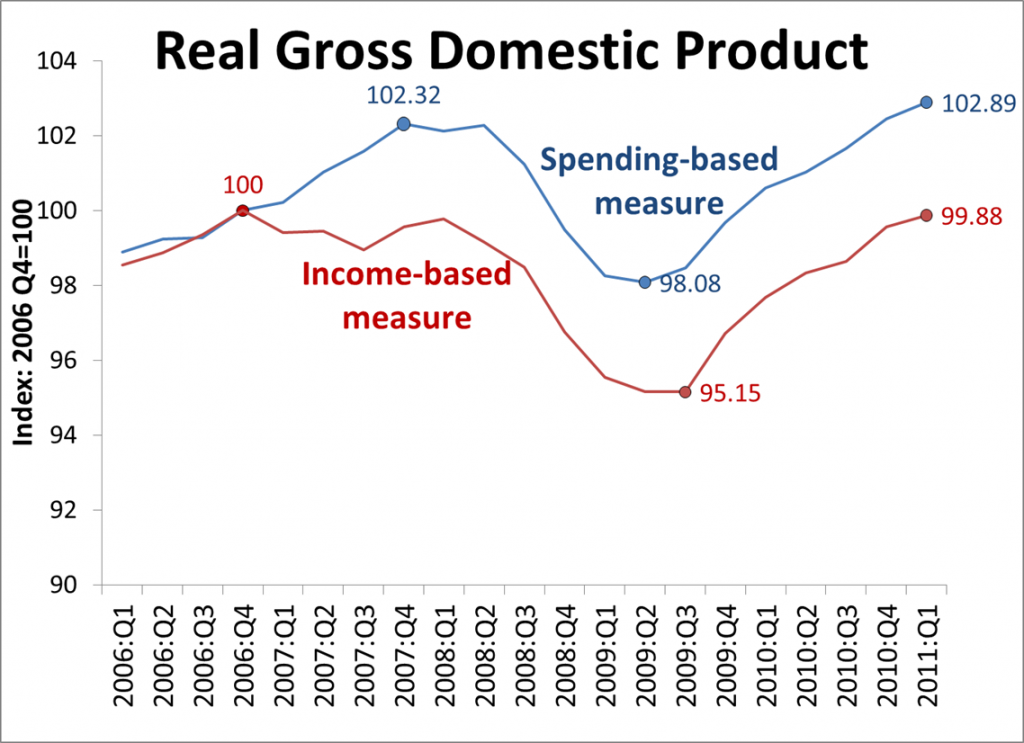
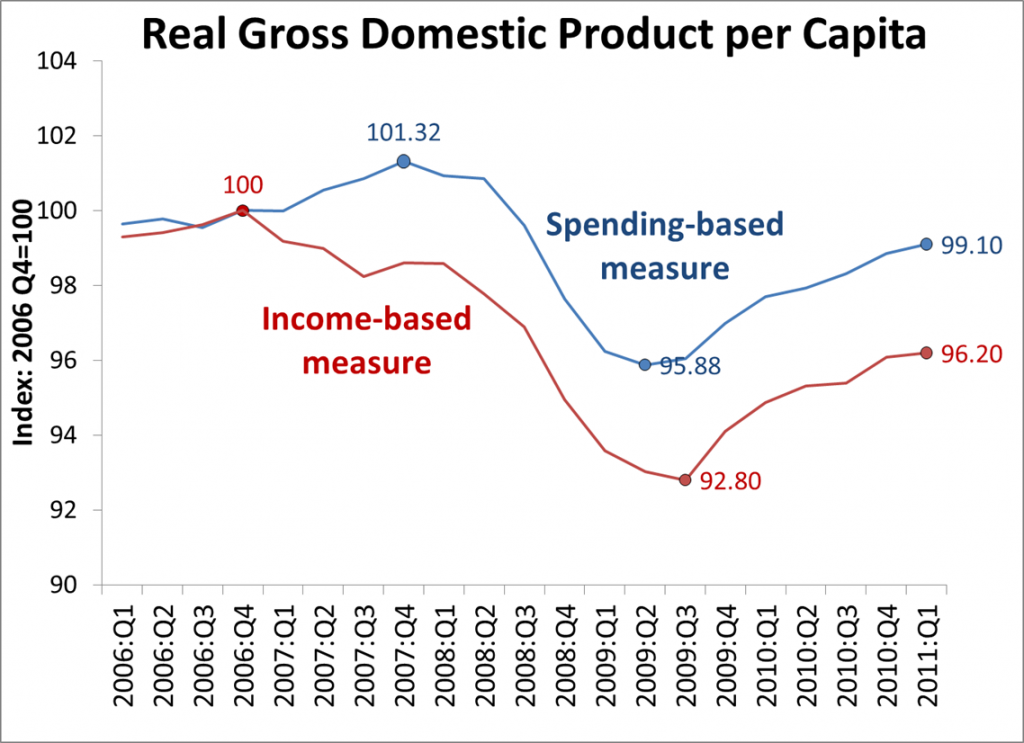
Justin Wolfers on the Freakeconomics blog has a good post showing that if you measure GDP by income, instead of the more usual spending, the recession has been longer and deeper - and we still have not fully recovered. This explains more fully why people still say we are in recession when people in Washington tout that we have been in recovery for years. The two good charts from the post are:


FRBSF Ecnomics Letter - Education & Monetary Policy
John Williams, president of the San Fransisco Fed published a letter about how he thinks economics education needs to adapt the teaching of monetary policy to reflect the recent actions of the Fed.
Greek Problem - Good Charts
One of the big questions in the world economy right now is how long can the Europe crisis go on and when will it break. The German magazine Spiegel has the following charts showing the worsening condition for Greece - it does not look good.
The first chart shows clearly how debt growth is outpacing GDP growth (which is negative).

Clearly Greece is going down (unless the Germans want to permanently support them). One of the big unknown is the losses a Greek (and Irish and Portuguese) restructuring will do to European banks - will the debt crisis cause a European Lehman crisis. The balance sheet of the ECB is looking shaky, as shown in the chart below.

The first chart shows clearly how debt growth is outpacing GDP growth (which is negative).

Clearly Greece is going down (unless the Germans want to permanently support them). One of the big unknown is the losses a Greek (and Irish and Portuguese) restructuring will do to European banks - will the debt crisis cause a European Lehman crisis. The balance sheet of the ECB is looking shaky, as shown in the chart below.

Health Care - A International Comparison Chart
Paul Krugman has a good chart showing the quality and cost of health care around the world.


Charlie Rose - Krugman, Walker & Rogoff
Charlie Rose has interviews with Paul Krugman, David Walker and Ken Rogoff about the the current state of the economy: http://www.charlierose.com/view/interview/11710#schedule
Monday, May 30, 2011
Monetary Step Backward?
The New York Times has a good article about people in Utah pushing the state to adopt a law that would make it easier for people to buy things with gold and silver coins (based on the value of their weight). This is a Tea Party idea and it seems as if they want to push the idea of allowing states to coin their own money. There are a lot of ways to attack this, but it should be sufficient to say that the idea is a big step backwards and shows just how out of touch the Tea Partiers are with basic economics.
Tuesday, May 24, 2011
Christina Romer and the Strong Dollar
Christina Romer has a good piece in the New York Times Economic View column about the economics and politics of the dollar - basically, is a strong dollar a good thing? She does a good job explaining how currency markets set the value of the dollar and why having a strong dollar is more of a political issue than an economic concern. This is definitely a good article for students when discussing exchange rates.
Monday, May 16, 2011
Inflation on PBS Newshour
Paul Solman has a good piece on how inflation is measured and what inflation means in this video clip from the PBS Newshour.
Watch the full episode. See more PBS NewsHour.
Wednesday, May 11, 2011

Four Workers for Every Job
Catherine Rampell covers this in the New York Times Economix blog. The improving job numbers makes everyone think that we are out of the woods in terms of the economy. How far we have to go to get back to normal is still a big number. An indication of this is the number of jobless workers for every employment vacancy (this does not get into whether or not the jobless workers are appropriately skilled for the vacant jobs). The new, and improved number is: four jobless workers for each opening - still not good odds. This graph show this and puts it into historic relevance.


Tuesday, May 10, 2011
Mankiw's Three Big Questions
Greg Mankiw in the New York Times Economic View column posts the three big questions that are currently perplexing him. They are:
1. How long will it take for the economy's wounds to heal?
2. How long will inflation expectations remain anchored?
3. How long will the bond market trust the United States?
These are good questions, and Mankiw's explanation of why the answers matter are good. If students can understand that these are the important questions to ask, they have learned a lot.
1. How long will it take for the economy's wounds to heal?
2. How long will inflation expectations remain anchored?
3. How long will the bond market trust the United States?
These are good questions, and Mankiw's explanation of why the answers matter are good. If students can understand that these are the important questions to ask, they have learned a lot.
Role of Economics?
Edward Glaeser made his last post to the New York Times Economix blog today and it is worth the read. Glaeser's post explains his view of the purpose and limits of economics in an imperfect world - and what economists can add to the public debate on issues. It is a good short read into the philosophy of economics.
Friday, April 22, 2011
Dani Rodrik's Parable of Trade
Dani Rodrik posted his parable of trade and an explanation on his web page - it is a short and simple reading that shows the benefits (and social costs) of trade. This will be on my reading list from here on.
Friday, April 15, 2011
Deficit Debate - Krugman vs. Holtz-Eakin
The PBS News Hour has a good debate about the deficit and debt debate between Paul Krugman and Douglas Holtz-Eakin.
Watch the full episode. See more PBS NewsHour.
Subscribe to:
Posts (Atom)